
CRA generally assigns monthly, quarterly or annual GST/HST reporting periods according to qualifying taxable supplies. The usual thresholds are $1.5 million and $6 million; charities and listed financial institutions have special assignment rules. File each return and separately pay any balance by the applicable deadlines. CRA reporting periods.
Filing GST Return: How Your Period Is Assigned
CRA generally assigns a reporting period based on qualifying taxable supplies made in Canada, including supplies of associates, in the relevant fiscal-year calculation. The threshold excludes certain amounts, including supplies outside Canada, zero-rated exports, exempt supplies and taxable sales of capital real property. An eligible registrant can elect a more frequent period. Charities and listed financial institutions have special assigned-period rules. Consult CRA’s reporting-period chart.
| Reporting period | Assigned when annual taxable supplies are… | Return filing deadline | Payment deadline |
|---|---|---|---|
| Annual (corporations) | $1,500,000 or less | 3 months after fiscal year-end | Same, 3 months after fiscal year-end |
| Annual (sole proprietor, Dec 31 year-end, with business income for tax purposes) | $1,500,000 or less | June 15 of the following year | April 30 of the following year |
| Quarterly | More than $1,500,000 up to $6,000,000 | 1 month after period-end | Same, 1 month after period-end |
| Monthly | Over $6,000,000 | 1 month after period-end | Same, 1 month after period-end |
Under the usual assignment rules, $1.5 million or less means an annual period, with an election available for quarterly or monthly filing; the threshold uses the CRA’s qualifying-supplies calculation. A more frequent period can suit a business that regularly claims refunds, but it also means filing more returns. For an annual individual filer without the special December 31 business-income rule, the usual annual deadline is three months after fiscal year-end.
For an eligible annual individual filer with a December 31 fiscal year-end and business income for tax purposes that year, the payment deadline is April 30 and the filing deadline is June 15. Interest can apply to an unpaid amount after the applicable payment deadline; check any weekend or public-holiday adjustment. CRA deadlines.
An annual filer generally must make quarterly GST/HST instalments when net tax is $3,000 or more in both the previous fiscal year and the current fiscal year. Check CRA’s calculation and exceptions; instalments are generally due one month after each fiscal quarter. CRA instalments.
What Is the E-Filing of a GST Return?
Electronic filing means submitting the return through an applicable CRA digital channel, such as My Business Account, the standalone GST/HST NETFILE form, or CRA-certified software using Internet File Transfer. Most registrants must file electronically; charities, selected listed financial institutions and approved exceptions have different rules. CRA filing requirements.
Filing on paper when you’re required to e-file carries a real cost: a $100 penalty for the first paper return, and $250 for every one after that.
My Business Account lets you file without a separate GST/HST access code and view account information. Eligible registrants can also use standalone NETFILE with their four-digit code. Filing does not itself complete payment of a balance owing.
What Is Nil Return Filing in GST?
A nil return is the all-zero return used when there are no amounts to report. No sales alone do not establish a nil return: you may have other reportable amounts or eligible ITCs. A registrant must file the return due for each reporting period. CRA NETFILE instructions.
Missing a required return can trigger CRA notices. The ordinary late-filing penalty does not apply when the balance is zero or a refund is due; a separate penalty may apply for failing to comply with a formal demand to file. CRA filing penalties.
Penalties for Filing or Paying Late
If your return has a balance owing, missing the GST return filing deadline can trigger this statutory late-filing penalty; CRA does not charge it when the balance is zero or a refund is due:
| Penalty type | Statutory rate / amount | Application condition |
|---|---|---|
| Late-filing initial charge ($A$) | 1% of balance owing | Applied immediately once filing deadline passes with a balance owing |
| Late-filing monthly surcharge ($B times C$) | 0.25% of balance owing per complete month | Accrues monthly up to a statutory maximum of 12 months |
| Paper filing penalty (first occurrence) | $100 | Submitting a paper return when mandatory electronic filing applies |
| Paper filing penalty (subsequent occurrences) | $250 | Each repeated paper return submitted after the initial infraction |
| CRA Demand to File non-compliance | $250 | Failure to file a return after receiving a formal CRA Demand to File |
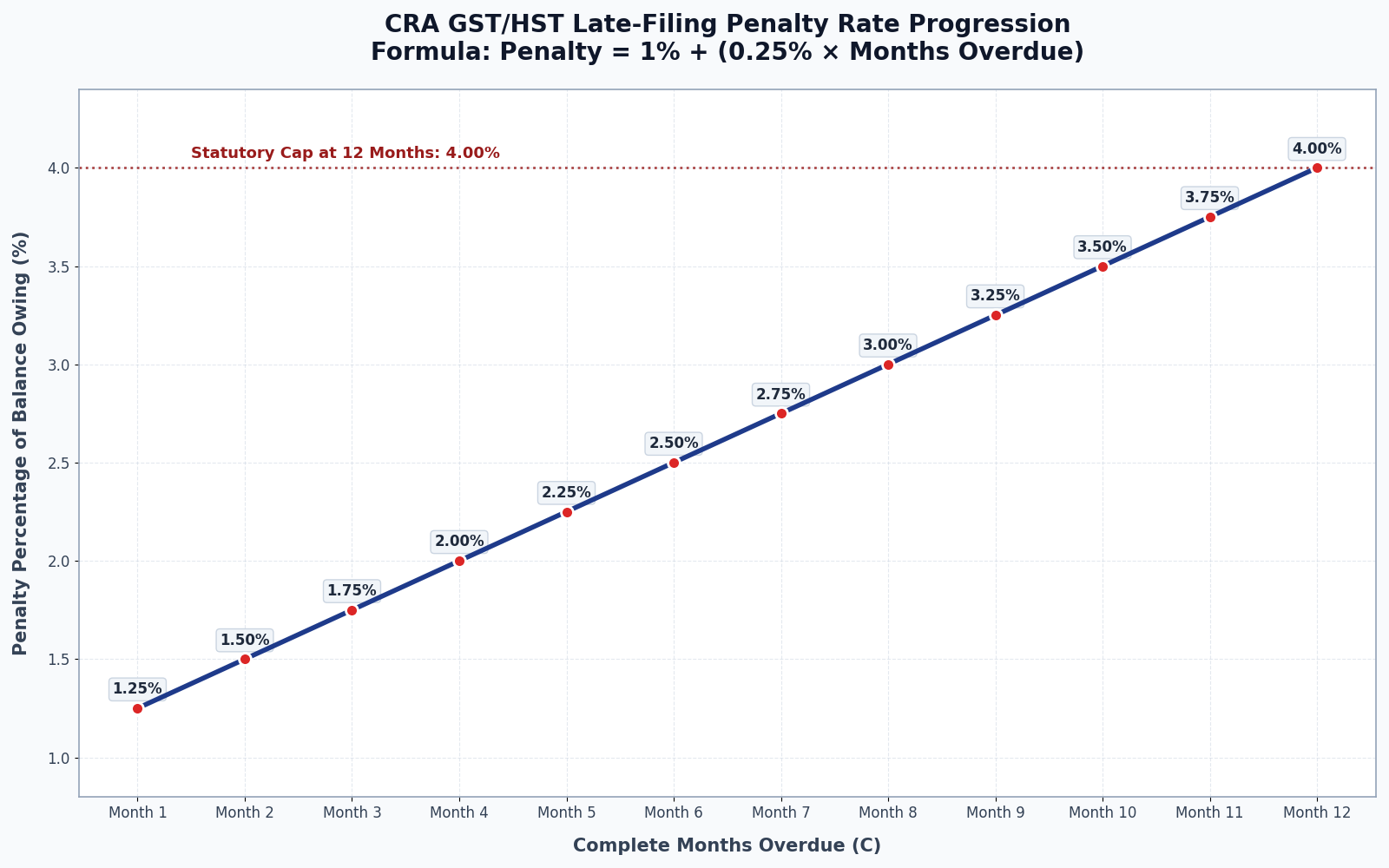
Statutory GST/HST late-filing penalty calculated under the CRA formula ($A + [B times C]$), excluding daily compounding interest.
Penalty = 1% of the balance owing, plus 0.25% of that balance for each complete month late, up to 12 months.
- A = 1% of the balance owing on the due date
- B = 25% of A
- C = number of complete months the return is late, capped at 12
If the CRA has issued a formal Demand to File and you still don’t comply, a flat $250 penalty applies on top. Failure to file and failure to pay are tracked separately: interest compounds daily on any unpaid balance from the day after the payment deadline, regardless of when — or whether — you eventually file.
If you get a CRA review letter asking for documentation behind an input tax credit claim, keep supporting documents because a credit card statement alone may not be enough; whether the supplier’s GST/HST registration number must appear depends on the purchase amount and other requirements. The CRA can ask for records going back six years from the end of the tax year they relate to.
Filing in Quebec: Revenu Québec, Not the CRA
Revenu Québec administers many GST/HST and QST accounts and provides combined filing, with special rules for selected listed financial institutions. Check the actual account’s assigned period, deadlines and applicable provincial requirements rather than assuming only the portal differs. Revenu Québec filing guidance.
If Revenu Québec administers the account, follow its filing instructions and the account’s assigned reporting periods. Selected listed financial institutions are subject to special rules.
Frequently Asked Questions
When is a GST/HST return due? Monthly and quarterly returns are generally due one month after the period ends. Most annual returns are due three months after year-end. The June 15 return and April 30 payment exception requires an individual annual filer with a December 31 fiscal year-end and business income for tax purposes in the year.
Can I file my GST return without My Business Account?
Yes — standalone GST/HST NETFILE lets you file using a 4-digit Web Access Code issued by the CRA, without logging into My Business Account.
Do I need to file if I had no income? Generally yes, for each reporting period. If every field is zero, use the nil-return option; no sales alone does not rule out other reportable amounts. CRA filing instructions.
What happens if I submit my GST return on paper?
Since reporting periods beginning January 1, 2024, paper filing triggers a $100 penalty for the first return and $250 for each one after, unless you fall under one of the narrow e-filing exceptions.
Related guides
Sources
Sources checked October 17, 2026.